Instagram Shadowban: How to Actually Check, Instead of Guessing
Instagram does not use the word shadowban, but something close to it exists, it is documented, and you can check it in about a minute. Here is the real mechanism, the in-app screen that reports it, and Meta's own published list of what puts an account on the wrong side of it.
·9 min read
A shadowban is the popular name for having your reach quietly cut without being told. Instagram does not use the word. Something close to it does exist, and Meta documents it in public.
Most articles on this subject offer a checklist of folklore. Post consistently. Drop your hashtags. Take a three-day break. None of it is testable, and none of it comes from Instagram.
There is a real answer. Instagram publishes the exact rules that decide whether your content can be recommended to people who do not follow you. It also has a screen in the app that tells you your current status. That turns a rumour into a check you can run in about a minute.
This guide covers what Instagram actually said about the term, the mechanism that genuinely exists, how to check it, and what puts you on the wrong side of it.
Key takeaways
Instagram's head, Adam Mosseri, addressed the term directly and said limiting content without explanation is not the intention.
The real mechanism is recommendation ineligibility. It affects Explore, Reels and suggested posts, not the feeds of people who follow you.
Account Status in the app reports whether your content can currently be recommended, and shows a sample of the posts responsible.
Meta publishes the list of what makes an account non-recommendable. Buying likes is named on it explicitly.
Repeated violations make an account ineligible for recommendation for a period of time, not permanently.
What Instagram said about the word itself
Adam Mosseri, who heads Instagram, addressed this directly in Instagram Ranking Explained. There is a section titled Addressing “Shadowbanning”.
He notes there is no single shared definition. People generally use it to mean content limited or hidden without explanation. His response is that this is not the intention when Instagram ranks content.
He also addresses the most common theory head on. Instagram does not suppress reach to push people towards buying ads. The stated reasoning is commercial rather than moral: a platform that grows reach for engaging content is a better business than one that throttles it.
Then comes the useful part. Mosseri writes that if anything makes your content less visible, you should know about it and be able to appeal. Account Status was built for exactly that.
The mechanism that genuinely exists
Instagram runs two separate rulebooks, and confusing them causes most of the panic.
Community Standards decide what stays on the platform. Break them and content is removed.
Recommendations Guidelines decide what gets shown to people who do not follow you. Meta states these are deliberately stricter, because recommended content comes from accounts the viewer never chose.
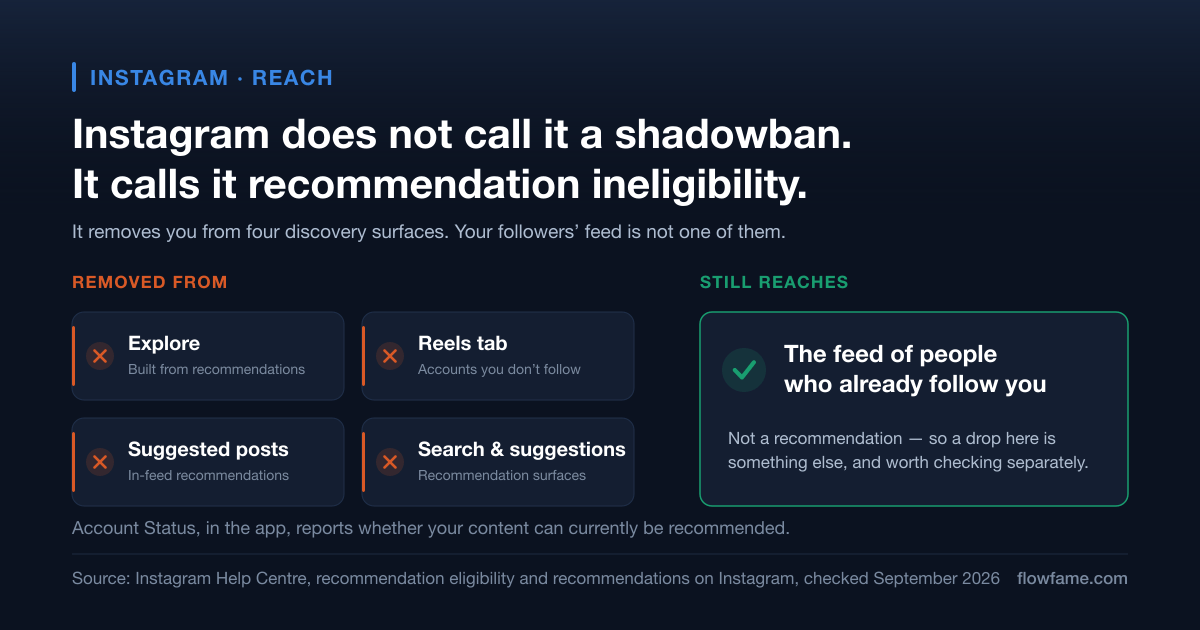
Falling foul of the second set does not remove anything. It makes your content ineligible for recommendation. That is the thing people are describing when they say shadowban.
Instagram is explicit about the scope, and this single sentence corrects most of what circulates: the guidelines apply only to public accounts, and only to recommendations shown to people who do not follow you. Even if you are not eligible to be recommended, your content still shows up for your followers.
Surface
Affected?
Why
Explore
Yes
Built from recommendations
Reels tab
Yes
Shows accounts you do not follow
Suggested posts in Feed
Yes
Recommendation surface
Search and Suggested Accounts
Yes
Recommendation surfaces
The feed of people who follow you
No
Not a recommendation
Private accounts
Not applicable
Guidelines cover public accounts only
What recommendation ineligibility affects, and what it does not. Source: Instagram Help Centre, recommendation eligibility.
That table settles a claim you will find on the first page of results for this topic. Several widely-read articles state that a shadowban stops your followers from seeing your posts. Instagram's own documentation says the opposite.
Two further details are worth having. If an account is not eligible to be recommended, none of its content is recommended, even the posts that break no rules. And eligibility is not a promise: being eligible does not mean you will be recommended.
Mosseri adds the duration. An account that repeatedly posts content against the guidelines becomes ineligible for a period of time. It is a temporary state, not a permanent mark.
How to check, in about a minute
This is the diagnostic that replaces guessing. It needs a professional account, meaning a business or creator account.
1
Open Account Status
In the app, go to Settings, then Account Status. On desktop, click More in the bottom left, then Settings, then Account Status.
2
Read your recommendation eligibility
Instagram states plainly whether your content may be eligible to be recommended to people who do not follow you. This is the answer to the question people call a shadowban check.
3
Look at the flagged content
If your content cannot be recommended, Instagram shows a sample of the posts responsible and names which guideline applies. That is the specific cause, not a guess.
4
Check your profile as well
Account Status also flags whether something in your profile breaches the guidelines. Your profile photo, bio and username are all assessed, not just your posts.
5
Edit, remove, or request a review
You can edit or delete the offending content from that screen. If you think the decision is wrong, you may be eligible to request a review.
What Meta says makes an account non-recommendable
Meta publishes this list. It is the closest thing to an official shadowban trigger list that exists, and it is short.
Instagram says it tries not to recommend accounts that:
Recently violated Instagram's Community Guidelines.
Repeatedly or recently shared non-recommendable content in the account name, username, profile photo, bio or profile.
Repeatedly engaged in misleading practices to build followings, such as purchasing likes.
Have been banned from running ads on Meta's platforms.
Recently and repeatedly posted false or altered information, as rated by independent third-party fact-checkers, in countries where Meta supports fact-checking.
Notice what is absent. There is no hashtag rule. No posting-frequency rule. No penalty for taking a week off. The folklore that fills most articles on this topic does not appear anywhere in Meta's list.
Notice also the second entry. Your bio and username are assessed. An account can be doing nothing wrong in its posts and still be non-recommendable because of its profile text.
What makes individual content non-recommendable
Separately, Meta lists three categories of content that are allowed to stay up but may not be recommended.
The first covers community safety: self-harm, violence, sexually suggestive material, and the promotion of regulated products such as tobacco, alcohol, weight-loss products or cosmetic surgery.
The third covers false or misleading content rated by third-party fact-checkers.
The second category is the one that catches ordinary creators, and almost nobody writes about it.
What Meta describes
What it means in practice
Unoriginal content largely repurposed from another source with only minor, immaterial edits
Reposting someone else's video with a caption added is a recommendation risk
Long captions unrelated to the underlying content
Keyword-stuffed captions that do not describe the post
Coordinated comment networks intended to artificially drive engagement and distribution
Engagement pods and comment groups
The low-quality category, in Meta's own terms. Source: Instagram Help Centre, recommendations on Instagram.
Engagement pods are still widely recommended as a growth tactic. Meta names them as a reason not to recommend content. Those two facts are rarely printed together.
The unoriginal content rule matters just as much. An account built on reposting trending clips is exposed here, even when every clip is harmless.
If Account Status is clean and reach still fell
This is the common case, and it deserves an honest answer rather than a hunt for a hidden penalty.
Reach moves for ordinary reasons. Instagram changes which formats it favours. Your posting time shifted. A previous post did unusually well and reset your expectations. Seasonal attention drops, which is pronounced across the Gulf during Ramadan and the summer travel months.
There is also a measurement trap. Engagement rate falls naturally as an account grows, because followers are the denominator. A rate that declines while your follower count climbs is arithmetic, not punishment. Our guide to engagement rate benchmarks covers why published figures for this vary so widely.
Before concluding anything, measure it. Track the same metric with the same formula over several weeks.
The calculator below computes engagement rate from likes, comments and followers. Record the figure weekly rather than reacting to a single quiet post.
One limit worth knowing. Meta's documentation states that account metrics are stored for up to 90 days. Instagram will not show you last year's numbers, so keep your own record if you want a longer trend.
Frequently asked questions
How do I know if I am shadowbanned on Instagram?
Open Settings then Account Status on a professional account. Instagram states whether your content is currently eligible to be recommended to people who do not follow you, and shows a sample of any content that is causing a problem. No third-party checker can access this.
Does a shadowban stop my followers seeing my posts?
No. Instagram's documentation is explicit that the Recommendations Guidelines apply only to recommendations shown to people who do not follow you. Your content still appears for your followers. Several popular articles claim otherwise and are wrong on this point.
How long does an Instagram shadowban last?
Instagram describes recommendation ineligibility as lasting for a period of time after repeated violations, rather than permanently. It does not publish a fixed duration. Account Status is where you see your current state.
Do banned hashtags cause a shadowban?
Hashtags do not appear anywhere in Meta's published list of what makes an account or post non-recommendable. The listed causes are guideline violations, profile content, misleading follower-building practices, ad bans and fact-checked misinformation.
Does Instagram limit reach to make me buy ads?
Mosseri addressed this claim directly and said Instagram does not suppress content to encourage ad purchases. The stated reason is commercial — growing reach for engaging content makes the platform more valuable than throttling it does.
Can buying followers or likes get me shadowbanned?
Meta lists accounts that have repeatedly engaged in misleading practices to build followings, such as purchasing likes, among those it tries not to recommend. We sell growth services and we would still tell you to read that sentence carefully before deciding.
The honest summary is that the word shadowban describes something real, but not what most people think.
What exists is recommendation ineligibility. It is published, it is temporary, it affects discovery rather than your followers, and Instagram reports your status in the app. That makes it one of the few account problems you can actually diagnose instead of guess at.
So check Account Status before changing anything. If it is clean, our guides to what actually counts as a view and engagement-rate benchmarks cover the measurement traps that explain most of what looks like a penalty. If it is clean, the problem is distribution or measurement, and both of those are worked on differently from a penalty.
Written and fact-checked against Instagram's own documentation in September 2026 by the FlowFame editorial team. Meta revises these guidelines, so Account Status in your app is always more current than any article, including this one. Spotted something out of date? Contact us, and read more About us.
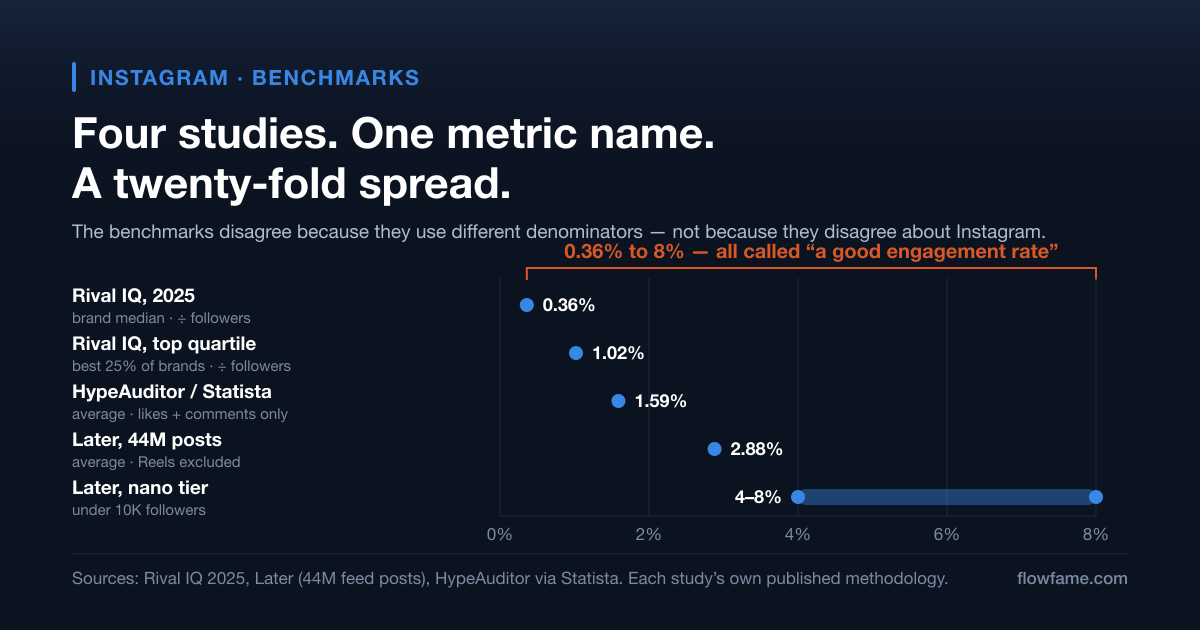
Published benchmarks put a good Instagram engagement rate anywhere from 0.36% to 8%. That is a twenty-fold spread for one metric. The gap is not disagreement about Instagram — it is four different formulas wearing the same name. Here is how to tell which benchmark your number can actually be compared to.
$
Engagement rate
4.25%
Interactions per post
425
Calculated from the numbers you entered, using the by-followers definition that brands quote. We don't show a “good” benchmark to compare against: every published band traces back to one vendor's private dataset, and what counts as strong depends on your size and niche. Your own trend over time is the more useful comparison.