What Counts as a View on Instagram? Meta's Definition Has No Time Limit
Guides will tell you a view needs three seconds, or one millisecond, or genuine attention. Meta's own documentation says none of those things. Here is the published definition, what it quietly includes, and why Meta itself tells you not to plan around the number.
·9 min read
Search for what counts as a view on Instagram and you will find four confident answers. A view takes three seconds. A view takes one millisecond. A view needs no minimum at all. A view requires that someone genuinely stopped to look.
Those cannot all be true. Only one source settles it, and it is not a marketing blog.
Meta publishes the definition in two places, and both say the same thing. A view is the number of times your content was played or displayed. There is no time threshold in that sentence, because there is no time threshold in the metric.
That single fact explains most of the confusion. The rest of this guide covers what the number quietly includes, when it changed, and the warning Meta attaches to it that almost nobody repeats.
Key takeaways
Meta defines a view as content played or displayed. No published minimum watch time exists for it.
Views count the same account more than once. Viewers counts each account once, which is the number people usually mean.
For reels, an account can be counted as a viewer without the reel ever playing.
Views on reels crossposted to Facebook include the Facebook plays, inside the figure shown in the Instagram app.
Meta labels these metrics in development, and its own guidance says not to use such metrics for important decisions.
Insights reach back 90 days only, so last year's numbers cannot be recovered from Instagram.
What Meta actually publishes
Instagram's Help Centre and Meta's developer documentation define the same metrics for the same platform. They agree with each other, and they disagree with most of what ranks for this question.
Here are the definitions in Meta's own words.
Metric
Meta's definition
Counts one account twice?
Views
The number of times your content was played or displayed. Content includes reels, posts, stories, live videos and ads.
Yes
Viewers
The number of unique accounts that have seen your content on screen at least once.
No
Reach (API name for viewers)
The number of unique accounts that have seen your content, at least once, including in ads.
No
Interactions
The number of actions people take when they engage with your content, such as likes, comments, saves and shares.
Not applicable
Metric definitions quoted from Instagram's Help Centre and Meta's Instagram Platform API reference, both checked September 2026.
Read the first row once more. Played or displayed. Not played for three seconds, not displayed for a measurable interval, not viewed attentively.
None of the popular thresholds appear anywhere in Meta's current documentation for this metric. A guide that gives you a number in seconds is describing something Meta does not publish.
Views and viewers are different questions
When someone asks how many people saw a post, they mean viewers. Instagram leads with views instead, and the two behave differently.
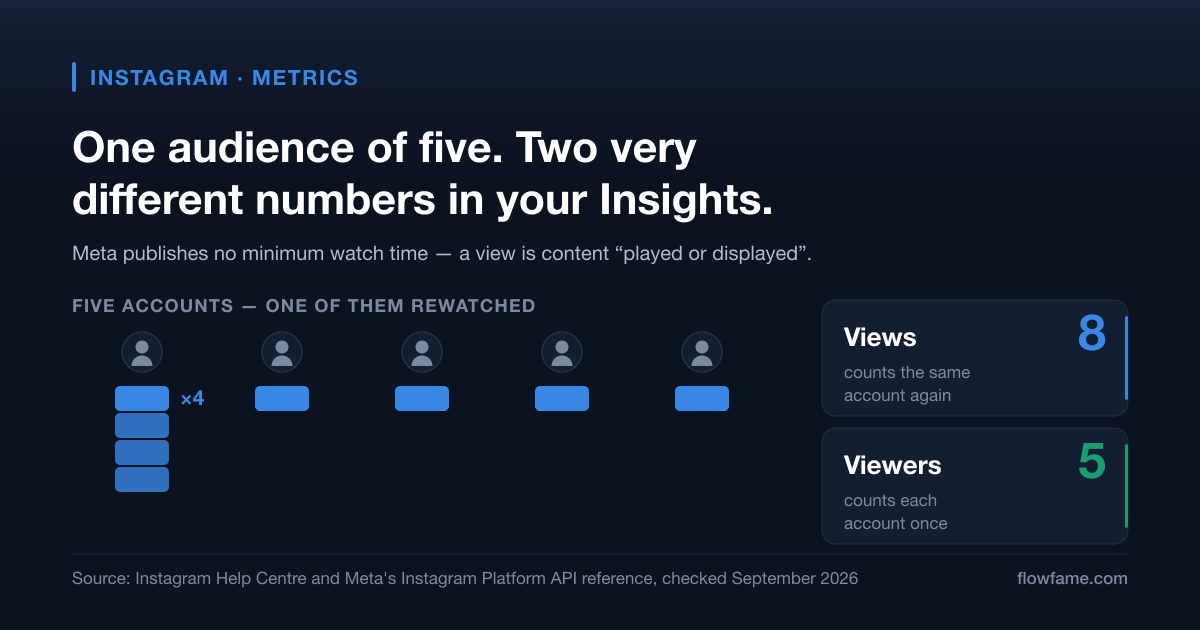
Viewers is the number of unique accounts that saw your content at least once. Views counts repeats; viewers does not.
One account that watches a reel four times contributes four views. Viewers counts that account once, however many times it comes back.
Reels add a further wrinkle that Meta states plainly. For reels, viewers is the count of unique accounts that saw the reel on screen at least once, whether or not the reel played. An account can therefore appear in your viewers figure having never triggered playback.
So the two numbers answer separate questions. Views measures how often your content was served up. Viewers measures how many people it actually reached.
What the number quietly includes
The definition mentions ads, and Meta's changelog adds two more inclusions that are easy to miss. Both inflate the figure relative to what creators assume they are reading.
The first is crossposting. Where a reel is also posted to Facebook, Meta aggregates the plays from both platforms, and that combined total is what surfaces natively in the Instagram app. The Facebook views are inside your Instagram number.
The second is boosting. Meta introduced an aggregated total that spans every surface, including boosted media and Facebook crossposts. It states that these totals match what users see in the Instagram Insights dashboard.
The practical consequence: if a reel was crossposted or boosted, the headline view count is not a measure of organic Instagram performance alone.
When the metric changed, and why old guides conflict
Much of the contradiction online is simply age. Instagram did not refine this metric quietly, it replaced several older ones, and Meta dated every step.
Anything written before these dates describes metrics that no longer exist. That is the honest explanation for most of the disagreement, and it is why publication dates matter more than confidence.
Date
What Meta changed
21 January 2025
Introduced views for both media and account insights. Deprecated impressions, plays, clips replays and aggregated reel plays for the then-current API version.
21 April 2025
Those deprecations applied to every API version. Requests for impressions on media created on or after 2 July 2024 return an error.
3 December 2025
Added crossposted views and Facebook views, confirming that reels crossposted to Facebook show an aggregated figure in the Instagram app.
22 April 2026
Added aggregated totals across all surfaces including boosted and crossposted media, stated to match the Instagram Insights dashboard.
Dates and wording taken from Meta's Instagram Platform changelog, checked September 2026.
One detail there is worth keeping. Impressions was the metric defined as content being on screen, and it is retired. Guides that explain views as appearing on screen are describing impressions under a newer name.
How much the number can be trusted
This is the part almost no guide mentions, and it is the most useful thing Meta publishes about views.
Instagram attaches a note to these metrics saying they are estimated and in development. Those are defined terms, not hedging language.
An estimated metric, in Meta's words, is derived through statistical sampling or modelling rather than a straight count. An in-development metric is one Meta is still testing and may adjust until it is accurate.
Meta then states what in-development metrics should not be used for: historical comparison of performance, and strategic planning or important business decisions. It recommends them for directional guidance only.
That guidance comes from the company that produces the number. A view count is a signal of direction, not an audited figure.
Limit
What Meta documents
History
Insights are available for any period within the past 90 days. Older data is not retrievable.
Freshness
Data used to calculate metrics may be delayed by up to 48 hours.
Account privacy
A public account is required. Switching to private removes access, which returns if you switch back within 90 days.
Audience demographics
Require a preset timeframe and more than 100 accounts reached or engaged.
Small accounts
Follower count and online follower metrics are unavailable below 100 followers.
Reporting limits documented by Meta for Instagram insights, checked September 2026.
Reading your own view count honestly
1
Decide which question you are asking
If you want to know how many people saw it, read viewers, not views. Views answers how often it was served, and those are different numbers.
2
Check whether the post was crossposted or boosted
If it was either, the headline figure spans surfaces. Compare it only to other posts handled the same way.
3
Compare like formats only
A reel view and a static post view are both plays or displays, but the surfaces behave differently. Judge reels against reels.
4
Give the number two days to settle
Meta documents delays of up to 48 hours. A figure read an hour after posting is provisional.
5
Record what you want to keep
Insights hold 90 days. Any comparison longer than a quarter has to come from your own records, because Instagram will not have it.
6
Treat it as direction, not as an audit
Meta labels the metric in development and advises against using such metrics for important decisions. Watch the trend rather than the digit.
Check your engagement rate against your real audience
$
Engagement rate
4.25%
Interactions per post
425
Calculated from the numbers you entered, using the by-followers definition that brands quote. We don't show a “good” benchmark to compare against: every published band traces back to one vendor's private dataset, and what counts as strong depends on your size and niche. Your own trend over time is the more useful comparison.
One practical use for the distinction: engagement rate. Dividing interactions by views flatters the result, because views counts repeats. Dividing by followers or by viewers compares like with like.
The calculator above divides by followers, which is the convention Instagram's own engagement metric uses. Our guide to Instagram engagement rate benchmarks explains why published benchmarks vary so widely, and which ones your number can fairly be measured against.
If your views fell off a cliff
A sudden drop in views is usually one of three things, and only the third is a real problem.
It may be the metric change. Accounts comparing a figure from before the 2025 consolidation against one after it are comparing two different measurements.
It may be composition. If a run of posts was boosted or crossposted and the next run was not, the earlier numbers included surfaces the later ones do not.
Or distribution genuinely narrowed. That is the case where a starting push helps, and Instagram views are the lever that acts on it — though only once the first two explanations have been ruled out. That is worth investigating properly rather than guessing, and Instagram reports it in the app. Our guide to checking for an Instagram shadowban covers the account status screen that tells you directly, instead of the folklore tests that do not.
Frequently asked questions
How many seconds does a view take on Instagram?
Meta publishes no number of seconds. Its definition is content that was played or displayed, with no stated minimum. Any specific figure in seconds is either drawn from a retired metric or is an inference the source has not attributed to Meta.
Does watching my own post count as a view?
Meta does not document an exclusion for the account owner, and it does not publish the internal filtering it applies. Since the metric is labelled estimated, treat small movements on your own content as noise rather than proof either way.
Do repeat views from the same person count?
Yes. Views is a count of times content was played or displayed, so one account can contribute many. If you want unique people, read viewers, which counts each account once.
Why are my views higher than my reach?
Because they measure different things. Reach and viewers count unique accounts, while views counts every play or display including repeats. Views being the larger figure is normal and expected.
Why did my view count change after Instagram updated?
Instagram replaced impressions, plays and two reel-specific metrics with a single views metric in January 2025, applied to all API versions that April. Figures either side of that change are not comparable.
Do Facebook views appear in my Instagram numbers?
For reels crossposted to Facebook, yes. Meta's changelog states that the aggregation of views on both platforms is what shows in the native Instagram app.
Can I see my view counts from last year?
No. Instagram documents that insights cover any period within the past 90 days. Anything older has to come from records you kept yourself.
The answer to the question is shorter than the debate around it. A view is a play or a display, it counts repeats, it includes ads, and on crossposted reels it includes Facebook.
What Meta does not provide is a threshold in seconds. Anyone quoting one is describing a metric Instagram retired, and the retirement has a published date.
The more useful takeaway is the label. Meta calls these metrics estimated and in development, and advises against leaning on such metrics for important decisions. Read views as direction, read viewers when you mean people, and keep your own records for anything older than a quarter.
Written and fact-checked against each cited source in September 2026 by the FlowFame editorial team. Meta revises these metrics regularly, so check the changelog date before relying on a figure. Found something out of date? Contact us, and read more About us.
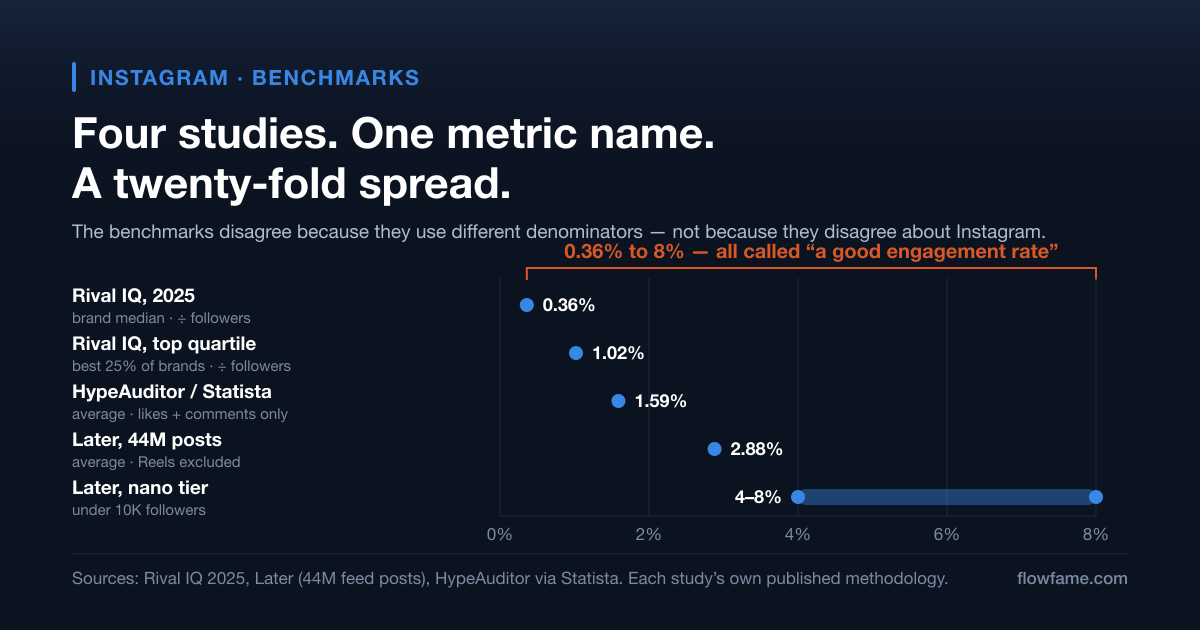
Published benchmarks put a good Instagram engagement rate anywhere from 0.36% to 8%. That is a twenty-fold spread for one metric. The gap is not disagreement about Instagram — it is four different formulas wearing the same name. Here is how to tell which benchmark your number can actually be compared to.
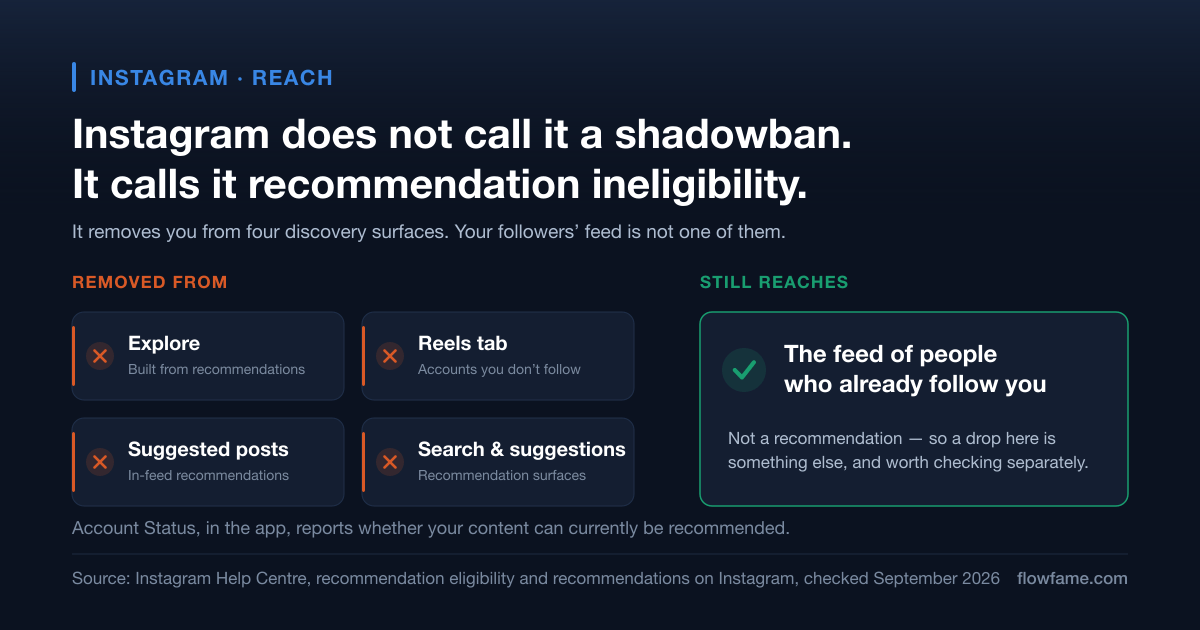
Instagram does not use the word shadowban, but something close to it exists, it is documented, and you can check it in about a minute. Here is the real mechanism, the in-app screen that reports it, and Meta's own published list of what puts an account on the wrong side of it.